·
01 · Woodward · Brand Operating System

The Woodward Brand Operating System

A talented team, a demanding new brand, and no budget to bridge the gap. So I built the bridge. Designed, engineered, and shipped solo.

Production software, AI-in-the-loop — 30 tools · 4 live instances · built solo · Anthropic API · React · TS.
The full story
Woodward Brand Operating System
The Launch Film
Click to play · 2:03

Governs the brand. Teaches the team to run it.

The lineageI could build this bridge because I'd spent fourteen years building it by hand — across Killington and a decade of campaigns with the teams that made them. Woodward is where the tooling finally existed to encode it.

at a glance / the facts
Client
Woodward · POWDR
Role
Creative Director · Product Creative Technologist
Years
2024–2025
Disciplines
Brand system · Product · AI tooling
Stack
React · TypeScript · Supabase · Netlify · Anthropic API
Scale
Four instances — PA · Park City · Tahoe · Copper
01The problem

A brand is a conversation. Drift is forgetting you're having it.

At Woodward, by late 2024, the conversation was getting harder to hold. Not because anyone stopped caring. Because the people being asked to carry the brand hadn't been given what they needed to feel sure of it.

The context matters. Woodward had been evolving for years. The "We Live This" positioning that Heather Driscoll and Mietra Byers launched in 2018–19 was a real high-water mark, backed by a TV show that ran on Fuel TV and YouTube and told the story of what camp actually felt like. Then the show went stale, the format stopped fitting how social media had changed, and it got shelved. The business moved on from gym and cheer, the easiest audience to turn into campers. A proud brand settled into a long stretch of decline, and decline makes it hard to keep specialized marketing talent in the building.

So here's where we actually were. A lean team, doing sophisticated brand work, without the specialists that work usually requires and without the budget to hire them in. Talented people. But circumstance had never handed them the confidence or the understanding to bring a demanding new positioning to life, and they were being asked to do exactly that.

The gap showed up in the work. Copy that read like it came from ten different people instead of one brand, because we had no writer on staff. Content collected beautifully all summer, then never digested or shared in a way the team could actually use. And Canva.

Canva wasn't the villain, exactly, but it's the clearest picture of the problem. Open it and you're met with fifty thousand templates, not one of them built for our brand. It had become a graveyard of every campaign we'd ever run, stitched together into a Frankenstein of mismatched creative. No governance, no accountability, and no way for someone uncertain to know which of the fifty thousand options was the right one. The tool wasn't the problem. The absence of a confident path through it was.

You could feel the cost of that gap every week. When we brought on a social agency to chase perishable, on-trend content, Jaiylen Marrow and I spent months just teaching them our library and reworking what came back to fit the brand. Walking into the Tuesday production meeting meant bracing to rework, re-edit, and re-cut stories to fit whatever the narrative had become since last week. The work was real. It just kept getting redone
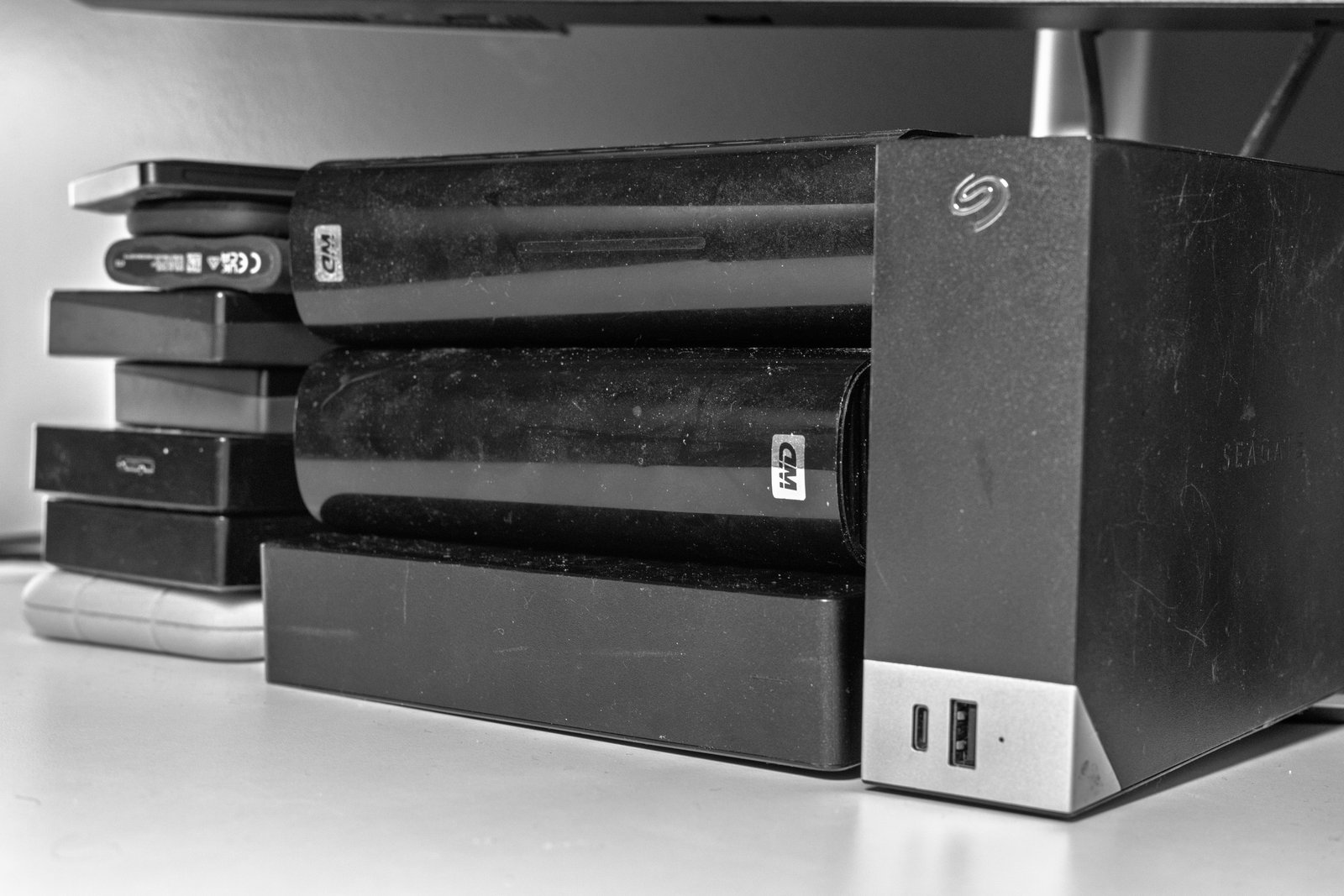
The graveyard

A graveyard of every campaign we'd ever run — stitched into a Frankenstein of mismatched creative, and drives full of content we'd captured all summer and never used. The value was already made. It just sat there, unapplied.

The Canva graveyard — thousands of off-brand templates and mismatched past campaigns, no confident path through
02The trigger

We couldn't hire the skill. So we built it.

December 2024. We'd just lost our on-site marketing manager at Woodward PA, a self-taught designer, right as we were closing in on the final stages of a rebrand. We needed a solve, fast. And a graphic designer wasn't coming. The budget wouldn't allow it.

That's the meeting where the BOS stopped being an idea and became the plan. The question wasn't "how do we build something impressive." It was "how does a team that can't hire the skills it's missing get those skills anyway." The answer I bet on: don't hire the skill. Build it into the tools, so the team levels up every time they use them

03The bet

A guide, not a cage.

I didn't want to write better guidelines. A guidelines document tells people what they got wrong after they've already done it, and it does nothing for confidence.

I wanted to build a system that gave the team the two things circumstance had denied them: understanding and the confidence that comes from it. Not a cage that stops you from going off-brand. A guide that shows you the on-brand path so clearly, and explains itself so well, that you start to trust your own hand. Governance and education as the same gesture. The guide is the tool.

Most brand systems protect the brand from the team. This one gave the brand to the team
The bet · a guide that makes the work

One 20-second clip. Sixteen assets. Five channels.

The wager was simple: a guide that doesn't just hold the rules but produces the work. Transcribe one clip once, and the system carries the story everywhere it can go — each output brand-correct from the start.

1 CLIP:20 TESTIMONIALTRANSCRIPTpremiere / whisperWEB4EMAIL3SOCIAL5PAID2LIBRARY2Hero pull-quoteBlog recapLanding blockSEO snippetSubject lineNurture insertNewsletter featureIG captionReel cutTikTokStoryYouTube ShortPaid social adRetargeting copyQuote librarySales enablement
04What I built

Thirty interlocking tools, one operating system.

Five connected pillars. Foundation, Voice, Create, Intelligence, System. Thirty interlocking tools, one operating system.

Foundation. Holds what the brand is: the assets, the rules, the source of truth. Live and queryable, wired into everything downstream instead of sitting in a file.
Voice. Where the writing problem got solved. I built the Brand Voice Studio, AI-in-the-loop, tuned to how Woodward actually sounds. But here's the part that matters: it doesn't just fix the copy. It tells you why it made the changes it did. Every edit is a small lesson. Use it enough and you stop needing it, because you've learned the voice. This one teaches. Especially as "Untamed Play" came online and the bar for the writing rose, the Studio is how a team without a writer started to sound like one brand instead of ten.
Create. The production engine, and where we cleared the graveyard. We cut the off-brand templates, trimmed the asset library to what served the current campaign, and limited fonts and colors to on-brand choices only. Then we wired it to our DAM in Canto, so the team always reached for the latest, correct assets. Fewer choices, all of them right, is what confidence looks like in a tool.
Intelligence. Where the system started to see. Jaiylen Marrow and I had built a content plan the summer before: roughly 218 pieces to carry the brand through the camp off-season. We were great at collecting against it and bad at digesting it. On-site camp directors couldn't see what had already been captured, so they'd re-shoot a story we already had. Jaiylen and I named that transparency gap together, and Intelligence closed it: scattered activity turned into shared visibility.
System. The connective tissue, the delivery lanes and exports that carry brand-correct work out to the partners who put it in market.
Interactive · brand consistency

Same brand, every hand.

Woodward's guide is a roadmap, not a rulebook — so consistency lives in the tools. One brief, five people, in the format you choose. Flip the system on to unify them, then click any asset to see what the system caught, and why.
The briefAnnounce mountain biking at Woodward PA.
Format
The system
ONOFF
◀ Flip it on
On-brand
38%
Interactive · brand voice studio

Rough draft in. Woodward out.

One of the thirty tools, live. Anyone drops in a rough line; the studio rewrites it in the Untamed Play voice — and shows the guardrails it fixed. Pick a draft:
Rough drafts from around the org
Rough draft
Woodward voice · Untamed Play
The flex · a brand that isn't Woodward

Start with the whole story.

Here's the flex: this isn't a Woodward story — it's Killington. Three minutes with Randy Elles, born and raised on the mountain. The same operating system runs on it just as cleanly, because the architecture was never hardcoded to one brand. Watch the film, then see what it does with a single twenty-second clip.

"Years" — Randy Elles, born & raised in Killington, VT.
Content & story · any brand

One story. Watch it deploy.

The first demo kept Woodward on-brand; this one points the same engine at a different brand entirely. One clip of Randy Elles' Killington story routes into on-brand content across every channel — tuned to that brand's voice, not Woodward's. Sixteen destinations, zero re-briefing.

01 · Choose a source clip — click any piece to watch the system deploy it down the marketing channels ↓
Transcript →
02 · The system deploys
Source · 16on-brand outputsfrom one clip · one transcript · 5 channels · 10 shown
The tools inside the system · by pillar
1 Foundation · 7 Voice · 13 Create · 3 Intelligence · 6 System.

Every tool built for the same three things: consistency, efficiency, and brand momentum.

Look at the balance — built overwhelmingly toward making the thing, not documenting it. A guidelines PDF is all foundation and no creation; this is the inverse. Real infrastructure with AI behind a serverless proxy, not a prototype — it shipped and ran the actual brand across four live instances. One operating system, four expressions, same architecture. Concept to working software, under one person.

The platform · four of thirty tools
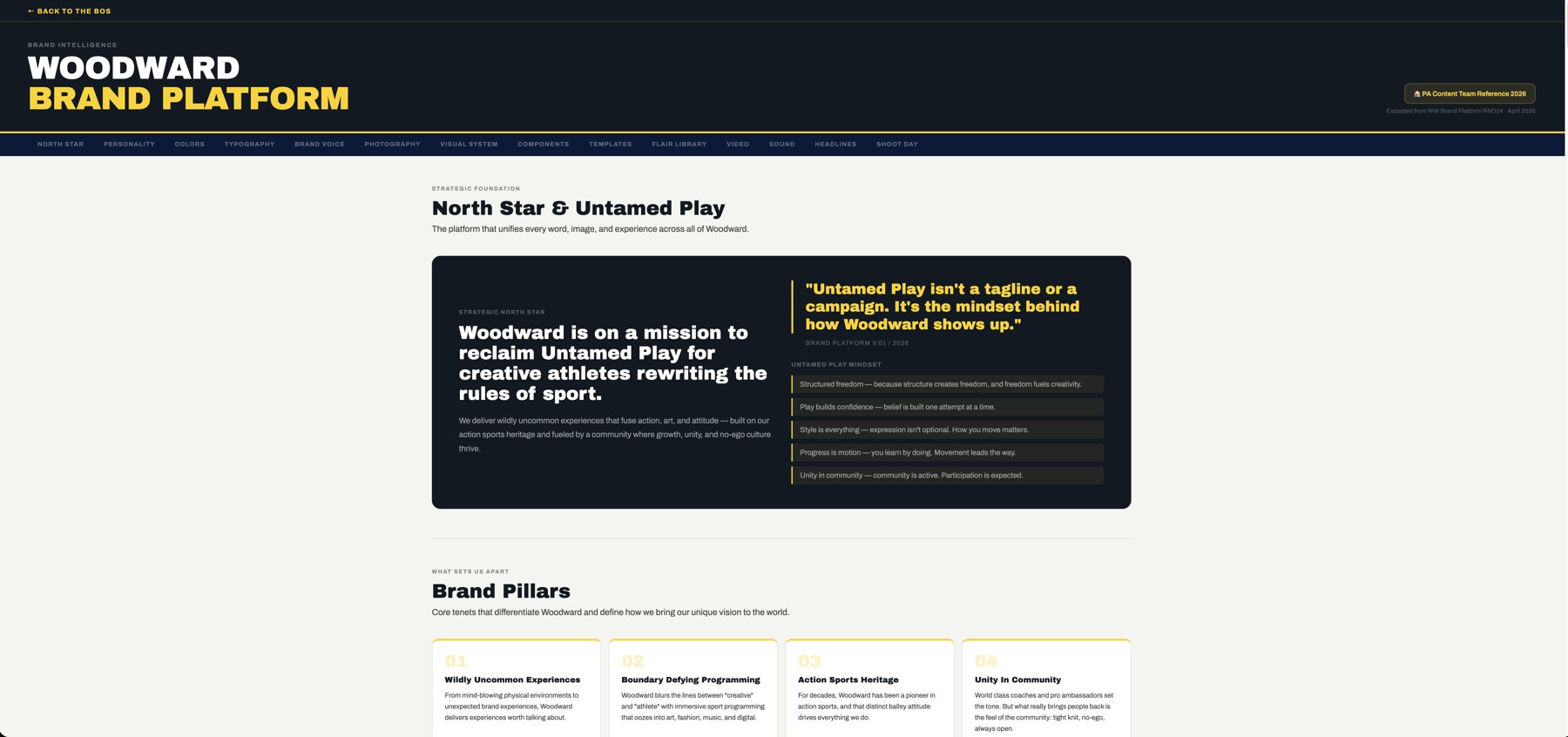
Woodward Brand Platform — North Star and Untamed Play mindset
Foundation. The North Star and Untamed Play mindset — one platform unifying every word, image, and experience.
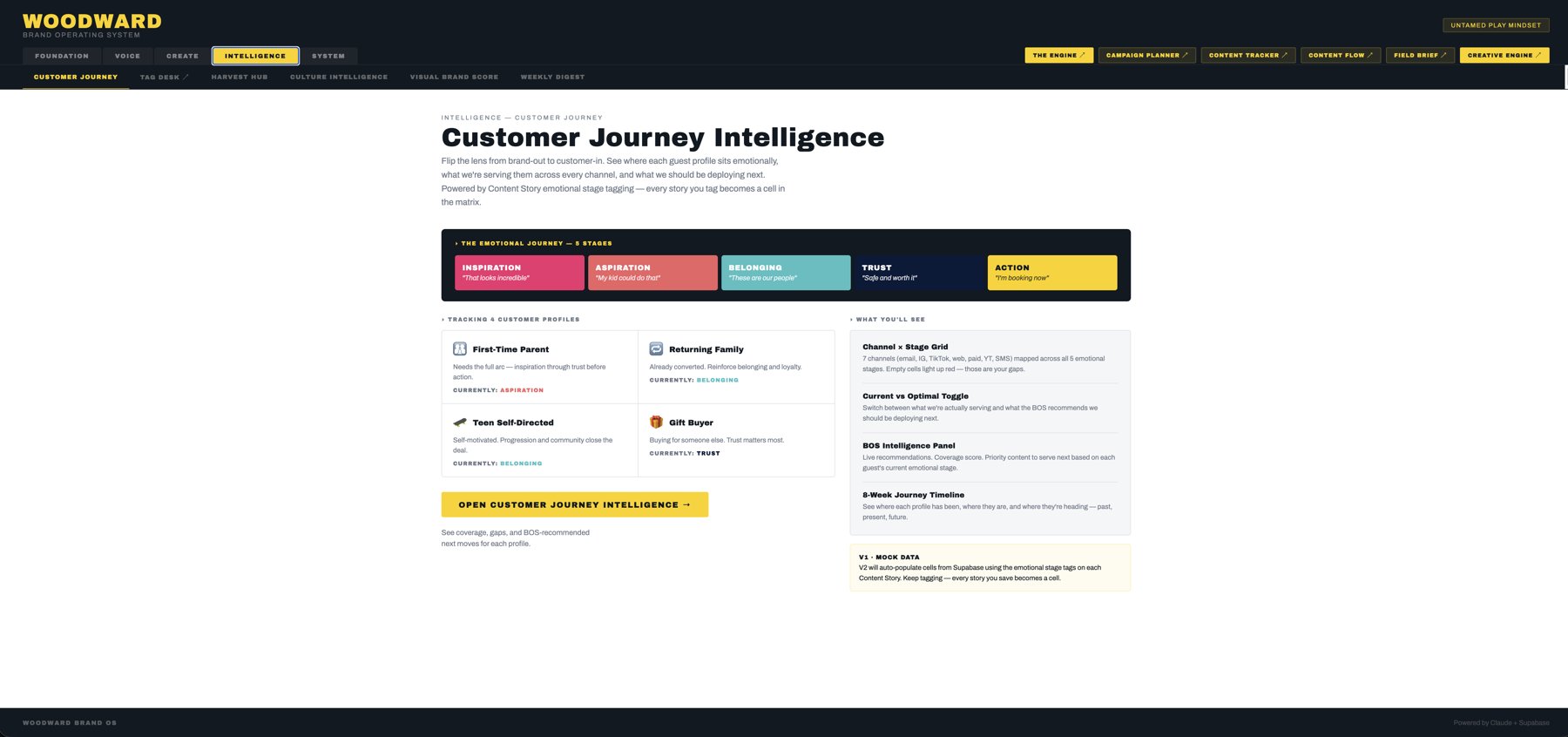
Customer Journey Intelligence — emotional stage matrix
Intelligence. Customer Journey Intelligence flips brand-out to customer-in — coverage, gaps, and the next move, lit in real time.
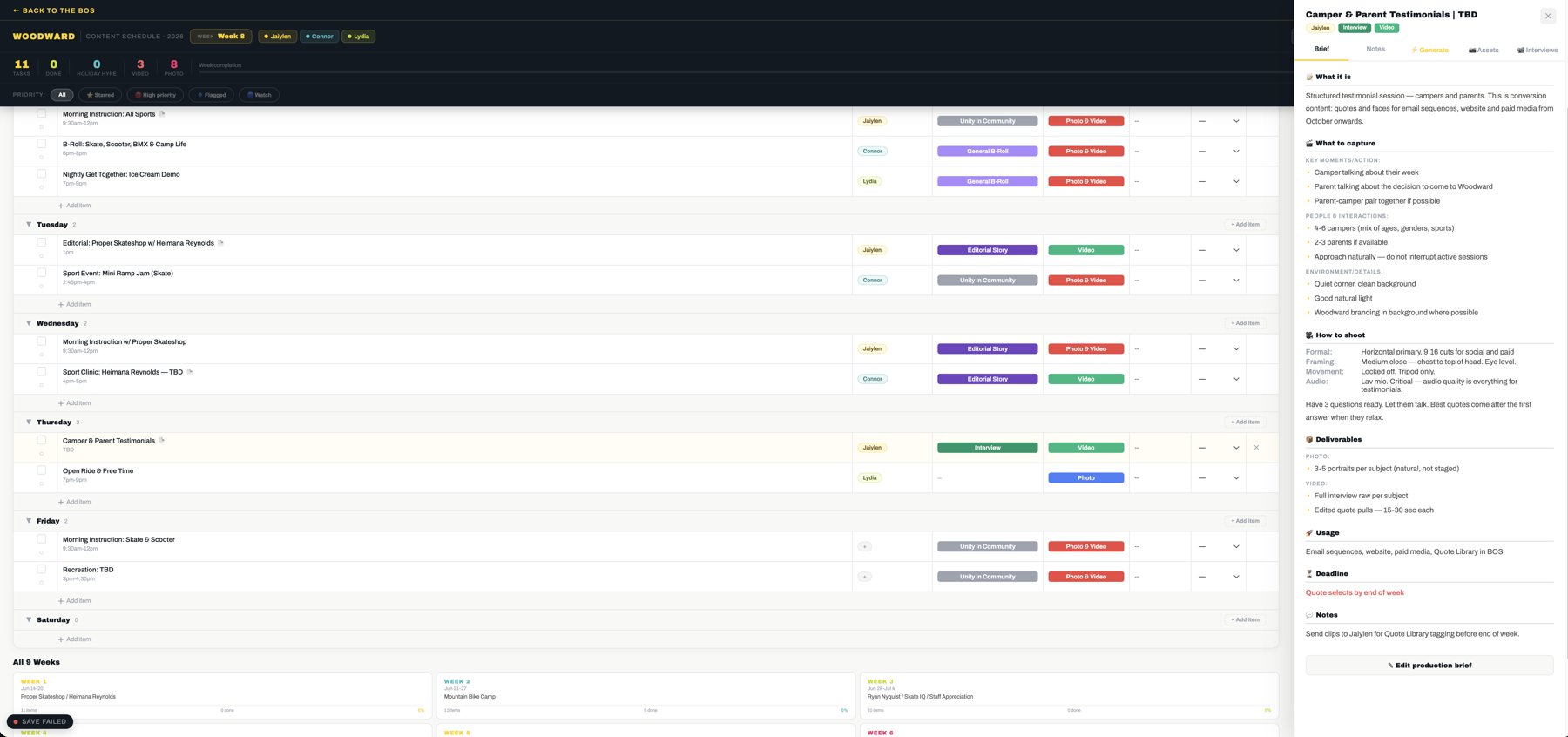
Woodward content schedule and production brief
Create. The content system — every shoot briefed, scheduled, and tagged to the brand before a camera rolls.
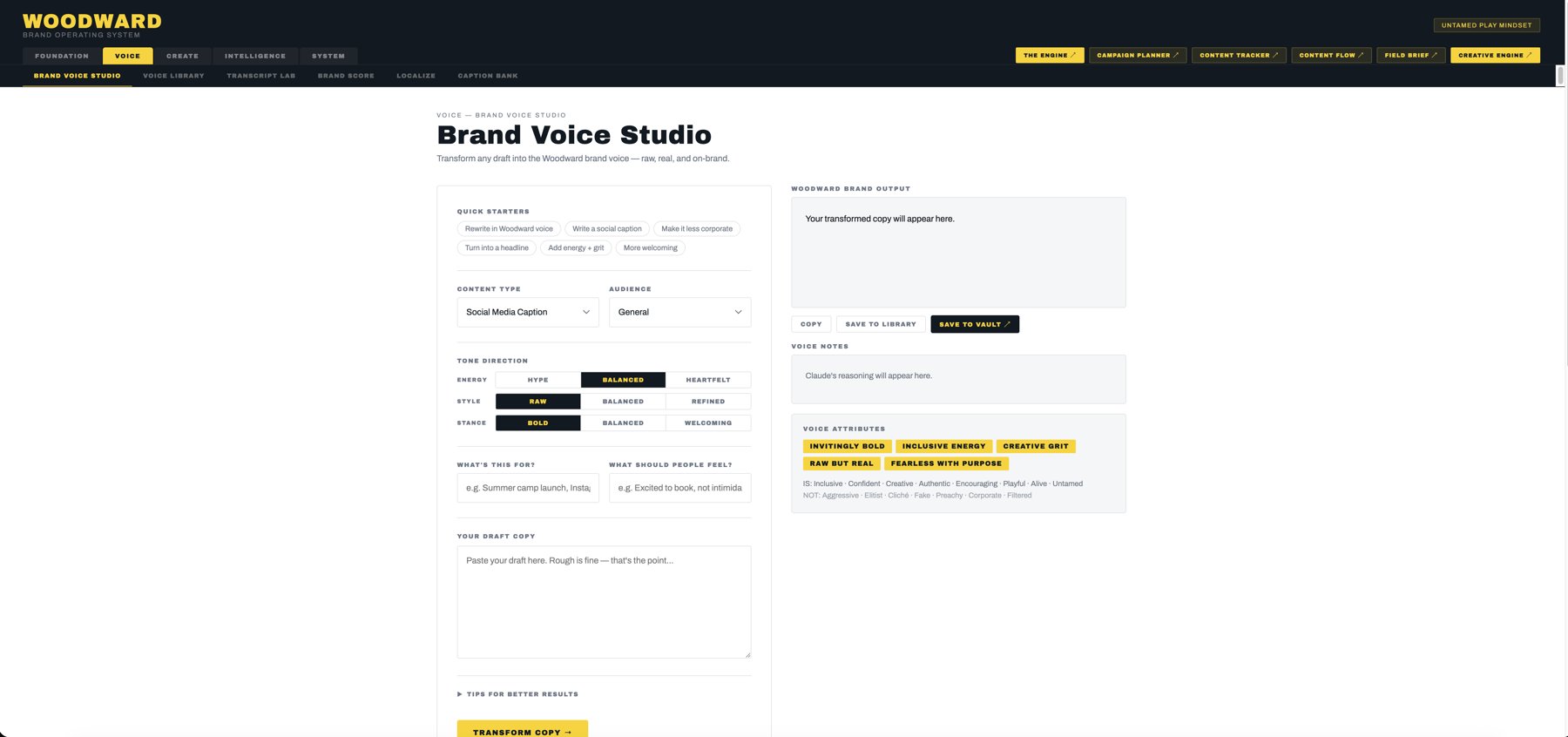
Brand Voice Studio — draft to on-brand copy
Voice. Brand Voice Studio — anyone on the team turns a rough draft into on-brand copy in one pass.
05What it returned

The BOS doesn't replace people. It amplifies them.

Here's the number, and I'll let it stand on its own.

Roughly $6,000 to $9,000 a year to run.

Notice what that number isn't. It isn't the cost of firing the agency. The agency investment stays, six figures, and worth every dollar. The BOS doesn't replace it. It multiplies it.

The six-figure investment produces more when the work feeding it is brand-correct from the start, when a team that used to sound like ten people now sounds like one, when directors can see what's already shot instead of re-shooting it. The small layer makes the big layer go further — and it does it by making the people better, not just the output.

Stop chasing. Start seeing. That was the thesis, and it held

~$6–9K
A year to run the whole system.
6-figure
Agency investment — multiplied, not replaced.
4
Live instances, one architecture.
06What it means

Story and system. One person.

I didn't come to this as an engineer who picked up marketing. I came to it as someone who spent two decades building brands people belonged to, then watched that humanity get diluted the moment it had to scale. The system exists because I got tired of watching talented people be set up without what they needed.

Here, the system does something more than hold the story steady: it keeps the story alive by teaching the team to tell it themselves. Running as four tuned instances, it already proved it adapts. What keeps one place steady can keep the next one. That's not a pitch. It happened.

This is the part most people can only half-claim. The ones who can tell the story usually can't build the system. The ones who can build the system rarely know what's worth protecting. The BOS is proof it can be one person. Concept to deployment. Story to system

I didn't come to this as an engineer.
What it made me

It proved the bet I'd made for a decade — that a brand's coherence can be engineered, not just supervised — and it turned me from a director who guides the work into one who can also build it.

Close ✕
Close ✕